
Digital Marketing Guide for Industrial Zones in Egypt | Egessia
A factory may have a strong product and good production capacity, but without a well-organized website, content that explains the product, visibility on Google, and campaigns aimed at the right audience, many opportunities can go unused.
That is why industrial marketing differs from marketing consumer products. The B2B buying decision is usually longer, and the customer needs technical and commercial information and trust before requesting a quote or starting negotiations.
In this guide we explain how to build a digital marketing strategy for factories in Egypt, the most suitable channels, and how the plan differs by sector, market and industrial zone.
If you are looking for a general comparison between marketing companies and choosing digital marketing services provider, you can refer to the guide to the best marketing companies in Egypt.
What Is the Digital Marketing Guide for Factories?
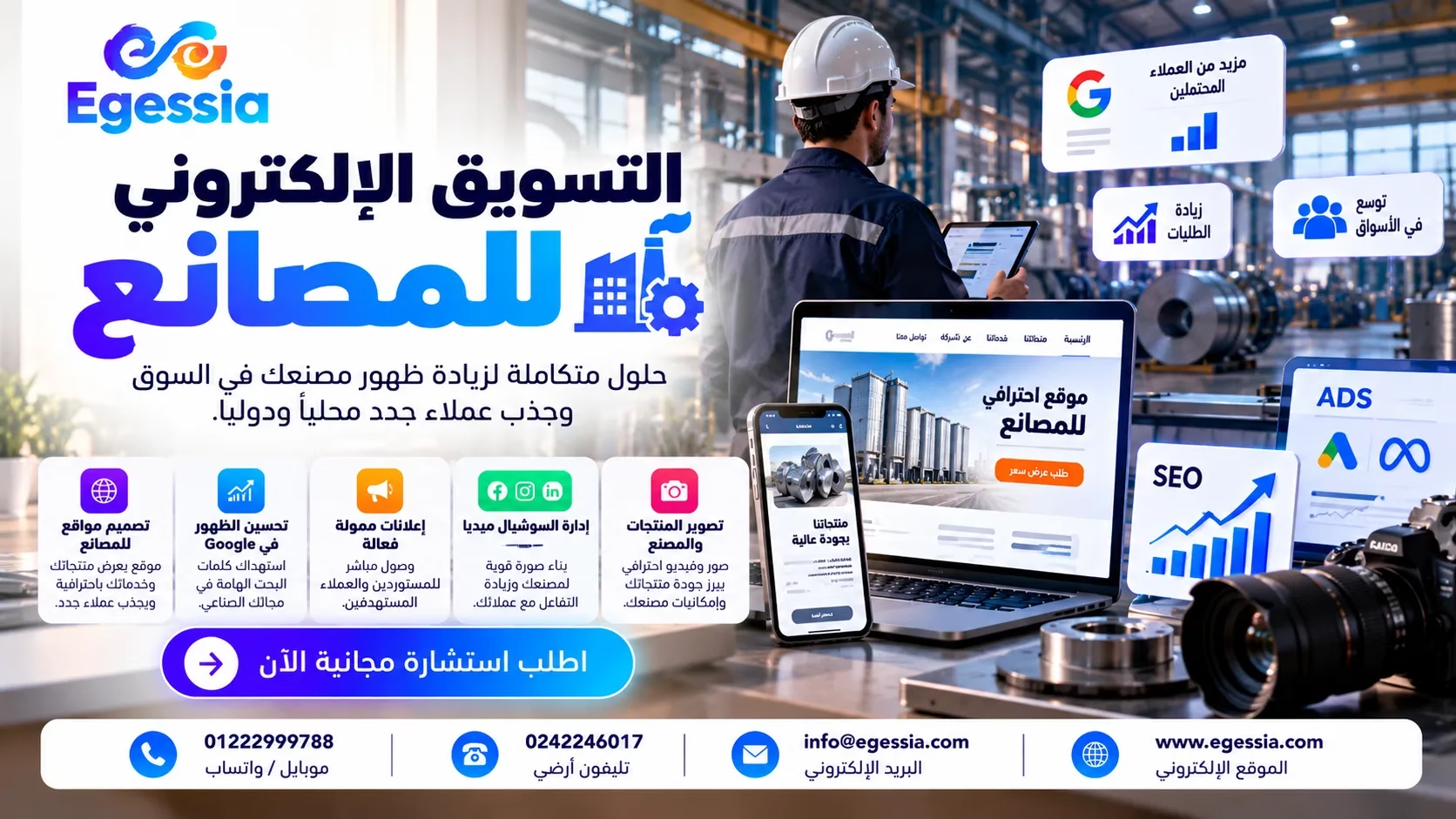
Digital marketing for factories is the use of digital channels to reach the companies, buyers, distributors and potential customers who need the factory’s products.
It can include:
- A professional website.
- SEO.
- Google Ads.
- LinkedIn.
- Social media management.
- Industrial content writing.
- Product and production line photography.
- Landing Pages.
- Email Marketing.
- Digital catalogs.
- Tracking and Analytics.
Channel selection should be based on the product, the market and the audience, not on using every available channel.
Why Is Marketing for Factories Different from Traditional Marketing?
An industrial customer usually does not make a buying decision after seeing a single ad.
They may need to know:
- Specifications.
- Raw materials.
- Production capacity.
- Minimum order quantity.
- Certifications.
- Accreditations.
- Supply track record.
- The markets the factory serves.
- Export capability.
- Delivery time.
Industrial marketing must therefore be able to support a longer, more complex buying decision.
Who Is the Factory’s Target Audience?
Before choosing any marketing channel, you must define who you are selling to.
The audience may be:
- Distributors.
- Wholesalers.
- Importers.
- Contractors.
- Real estate developers.
- Other factories.
- Procurement managers.
- Consultants.
- Engineers.
- Government projects or institutions.
Each segment needs a different message, pages and tools.
Goals of Digital Marketing for Factories
The goal should not be just “more visibility”.
Goals may include:
- Getting RFQs.
- Reaching distributors.
- Increasing supply orders.
- Entering new markets.
- Reaching importers.
- Supporting the sales team.
- Building trust in the industrial brand.
- Marketing a new product or production line.
- Supporting export.
The Factory’s Website
The website is one of the most important trust points in industrial marketing.
It should include:
- A clear overview of the factory.
- Product categories.
- A page for each product or sector.
- Specifications.
- Use cases.
- Certifications.
- Catalogs.
- Technical Data Sheets.
- Target markets.
- A portfolio or supply record.
- An RFQ form.
The website must help the business customer gather the information they need before getting in touch.
SEO for Factories
Search engine optimization helps the factory appear when a customer searches for a product, supplier, factory or specifications related to what it offers.
An SEO strategy may target:
- Product names.
- Specifications.
- Use cases.
- Suppliers.
- Manufacturers.
- Supply and wholesale keywords.
- Export keywords.
- Target markets.
Each page should have a clear goal instead of creating dozens of pages targeting the same keywords.
Google Ads for Factories
Google Ads can be a good fit when customers are already searching for the products or suppliers.
For example:
- Supplier of a specific material.
- Factory of a specific product.
- Wholesale Supplier.
- Manufacturer.
- Product Specifications.
The value of Google Ads in B2B comes from targeting the right search intent, not from simply increasing visits.
LinkedIn in Industrial Marketing
LinkedIn can be useful when the factory’s audience is made up of decision-makers and professionals.
For example:
- Procurement Managers.
- Project Managers.
- Engineers.
- Import Managers.
- Business Owners.
- Distributors.
It can be used for content, outreach or ads depending on the nature of the market.
Social Media for Factories
Social media should not turn into nothing but repeated product photos.
Content can be used to show:
- Products.
- Production lines.
- Raw materials.
- Quality tests.
- Use cases.
- Past projects.
- Supply projects.
- The team and the factory.
- Exhibitions.
- Certifications.
The goal is to build trust and clarify the factory’s capabilities.
Photographing Products and Production Lines
In industrial marketing, real photos are often more valuable than generic stock images.
Photography can cover:
- Products.
- Raw materials.
- Technical details.
- Production lines.
- The factory.
- Packaging.
- Warehouses.
- Shipping.
These materials can be used on the website, social media, catalogs and ads.
See also: The best digital marketing company in Egypt
B2B Industrial Content
Industrial content should speak to the person who makes the buying decision.
Topics can include:
- Technical specifications.
- Differences between products.
- Use cases.
- Selection methods.
- Standards and certifications.
- Technical questions.
- Supply.
- Product comparisons.
- Case Studies.
Generic “best quality and best price” content is not enough to build real trust.
Digital Marketing for Factories and Export
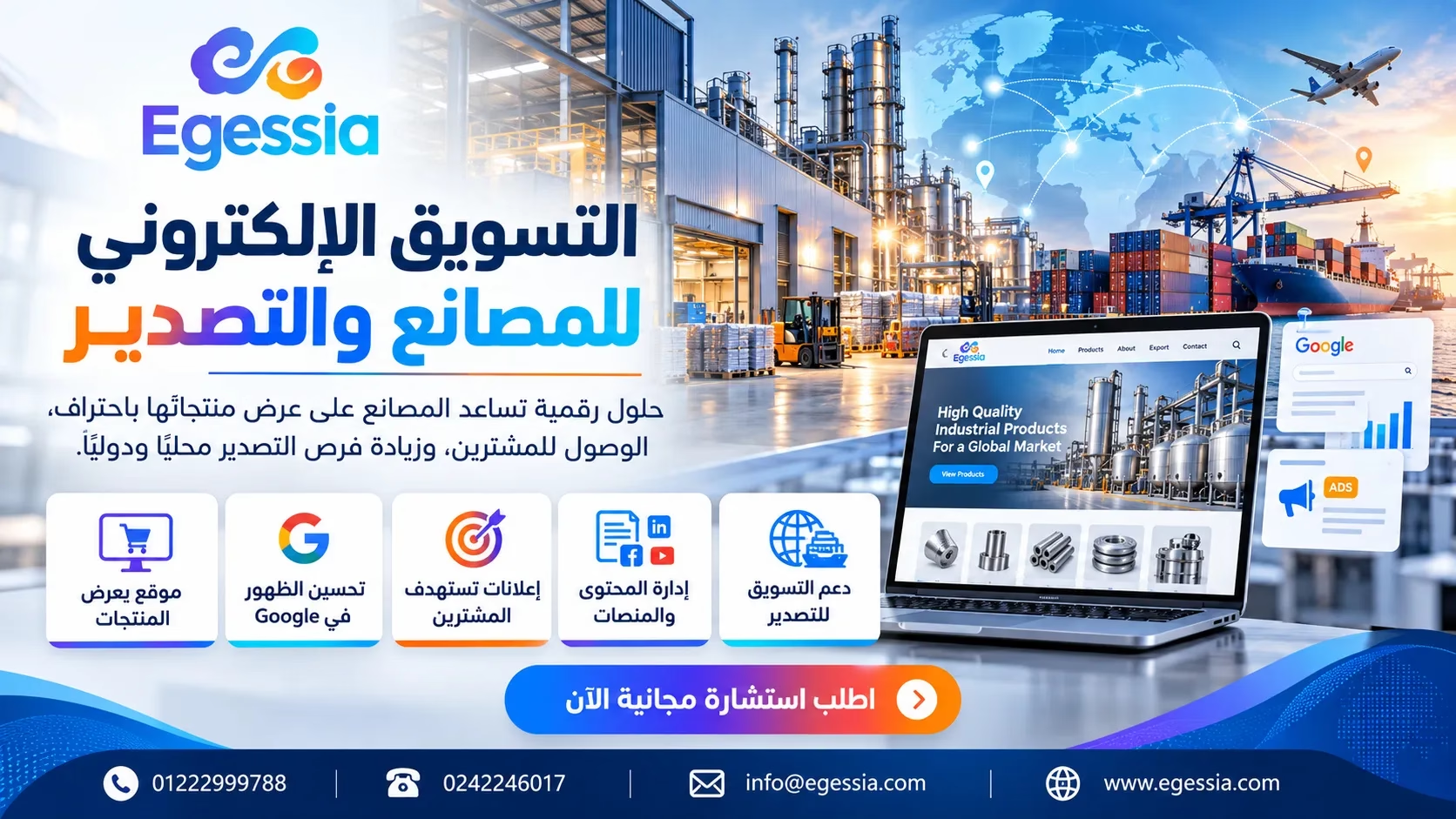
If the factory targets export, the plan must differ from local marketing.
You may need:
- A multilingual website.
- Pages for target markets.
- Content in English or the market’s language.
- International SEO.
- Export catalogs.
- LinkedIn Outreach.
- Google Ads in target markets.
- B2B platforms where suitable.
Marketing for Industrial Zones in Egypt
Egypt has diverse industrial clusters, and each zone has different sectors, markets and opportunities.
Geography alone does not define the plan; what matters more is the type of industry, the customer and the target market.
The main industrial clusters can be grouped into several axes.
Cairo and Its Surrounding Industrial Zones
Cairo and its surroundings include diverse industrial and craft zones, from light industries to engineering activities.
Factories here may need:
- Local SEO when there is a local market.
- Google Ads.
- Company websites.
- B2B content.
- Product photography.
Badr City and Al-Rubiki
Factories located in Badr and Al-Rubiki can benefit from plans combining the website, SEO, ads and industrial content, especially in the leather, textile and supply sectors.
El-Salam and the Ismailia Road
Industrial activities in these areas may need campaigns aimed at distributors, traders and companies, with clear service or product pages.
Shaq El-Thaban
The marble and granite sector usually needs strong photos, a multilingual website, product pages, and a strategy targeting both the local market and export.
Qalyubia and Its Industrial Zones
Qalyubia includes diverse industrial activities in plastics, metals, packaging and more.
Obour City
Obour City has factories across multiple sectors, and they may need:
- Well-organized product websites.
- Google Ads.
- SEO.
- B2B content.
- Distributor targeting.
Abu Zaabal and El-Khanka
Engineering and heavy industries need technical content and clear pages targeting companies, contractors and procurement managers.
El-Akrasha
Small and medium workshops and factories may need a practical start that includes a simple website or landing pages and a clear social presence.
Giza and Its Industrial Zones
6th of October City
6th of October City has a large number of factories and sectors, so the plan should not rely on a single channel.
It can combine:
- SEO.
- Google Ads.
- LinkedIn.
- The website.
- Content Marketing.
Abu Rawash
The presence of multiple engineering and manufacturing sectors makes product pages and multilingual websites important for companies targeting supply and export.
Sharqia
10th of Ramadan City
10th of Ramadan is one of the most important industrial cities, and companies there need marketing focused on products, business customers and target markets.
The plan can include:
- Website.
- SEO.
- Google Ads.
- LinkedIn.
- Content.
- Product Photography.
Belbeis and New Salhia
Depending on the industry, the focus can be on wholesalers, distributors and agricultural and food markets.
Suez and the Suez Canal Axis
Heavy industries, petrochemicals and export-related projects need a more specialized B2B strategy.
It may include:
- Technical content.
- English-language pages.
- LinkedIn.
- International SEO.
- Catalogs.
- Export Marketing.
Port Said and Its Industrial Zones
Factories in Port Said can benefit from their proximity to the Suez Canal axis in targeting export markets.
The approach differs by sector, but it can combine:
- A multilingual website.
- SEO.
- Google Ads.
- B2B Content.
- Export Assets.
Alexandria and Its Industrial Zones
Alexandria combines industrial sectors, a port and export markets.
Margham and El-Amaria
Factories in the plastics, chemicals and engineering sectors may need technical content and targeting of distributors and importers.
Borg El Arab and Surrounding Areas
Industrial companies can use the website, SEO and ads to reach local and international customers.
The Delta and Its Industrial Zones
Governorates such as Monufia, Dakahlia, Damietta and Beheira contain diverse industrial clusters.
Sadat City
Sadat City has factories serving different markets, so it needs a plan by sector, not a general plan for all factories.
Damietta
The furniture, decor and manufacturing sectors can benefit greatly from visual content, photography, websites and online stores when needed.
Gamasa
Factories targeting markets outside the governorate can use SEO, Google Ads and multilingual websites depending on the product.
Upper Egypt and Industrial Marketing
Geographic location is no longer the obstacle it was in traditional marketing.
Factories in Beni Suef, Minya, Assiut, Sohag, Qena and Aswan can reach customers inside and outside Egypt through digital channels.
Beni Suef
Engineering, food and medium-sized factories may need B2B content, product websites and search campaigns.
Minya
Industrial projects can use the website, Google Ads and SEO to support regional expansion.
Assiut and Sohag
Depending on the sector, the goal may be reaching traders and distributors within Upper Egypt or larger markets in Cairo and the Delta.
Qena and Aswan
Factories close to southern routes and markets may have opportunities to expand toward Sudan and African markets, which requires a dedicated study of the target market.
Sinai and Its Industrial Zones
Industrial projects in Sinai can use digital marketing to overcome geographic distance and reach larger markets.
They may need:
- Google Ads.
- A website.
- Clear content.
- Local SEO when needed.
- Export marketing depending on the product.
How Does the Plan Differ by Factory Type?
Food Factories
They usually need:
- Product photography.
- Social Media.
- Distributors.
- Retail / Wholesale Targeting.
- Seasonal Campaigns.
Engineering Factories
They rely more on:
- Technical Content.
- SEO.
- Google Ads.
- LinkedIn.
- Datasheets.
Building Materials Factories
They may target:
- Contractors.
- Distributors.
- Developers.
- Engineers.
- Projects.
Consumer Products Factories
They may rely more on:
- Social Media.
- Meta Ads.
- Influencer Marketing where suitable.
- Retail Campaigns.
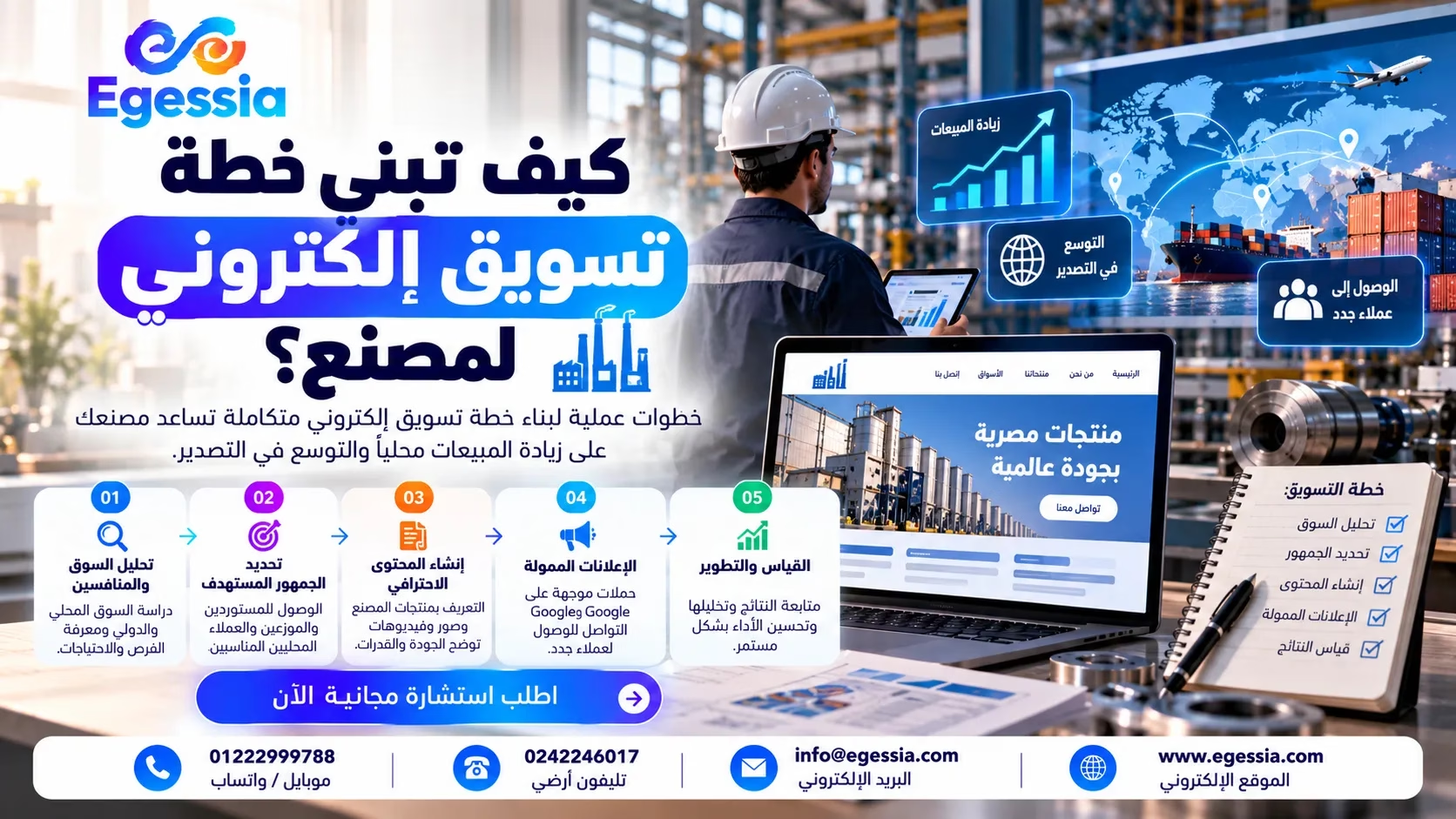
How Do You Build a Digital Marketing Plan for a Factory?
1. Define the Product and the Market
Do not start with the channel. Start with what you want to sell and to whom.
2. Define the ICP
Who is the ideal customer? A distributor, another factory, an importer or a contractor?
3. Define the Information the Customer Needs
Specifications? Price? MOQ? Accreditations? Supply?
4. Choose the Channels
Google, LinkedIn, Meta or Email depending on the audience.
5. Prepare the Assets
- Website.
- Landing Pages.
- Catalog.
- Photos.
- Datasheets.
6. Start Testing
Test messages, keywords and audiences instead of assuming what will work.
7. Measure Results
Track leads, their quality and their source, not just reach.
How Do You Measure the Success of a Factory’s Digital Marketing?
Indicators can include:
- Number of Qualified Leads.
- RFQs.
- Cost per Lead.
- Conversion Rate.
- Organic Clicks.
- Commercial Keyword Visibility.
- Number of catalog or sample requests.
- Export inquiries.
The indicators differ by sales model.
Common Mistakes in Factory Marketing
Relying Only on Social Media
Some industrial products are searched for more through Google or B2B channels.
No Strong Product Pages
The buyer needs information before making contact.
Using Generic Content
Generic phrases do not explain why the factory should be chosen.
Not Photographing the Real Product
Stock photos do not always reflect the factory’s quality and capabilities.
Measuring Success by Likes
In B2B, one qualified lead can be worth more than thousands of unqualified interactions.
Not Connecting Marketing to Sales
You must know what happened to the lead after it arrived.
When Do You Need a Company Specialized in Industrial Marketing?
You may need a specialized partner when:
- You target companies, not only consumers.
- You have products that need technical explanation.
- You want to reach distributors.
- You target export.
- You need more than one channel.
- Your in-house team does not cover SEO, ads, content and design.
Choosing the company itself is a different topic from this guide, and you can refer to the article digital marketing company in Egypt if you are at the stage of comparing service providers.
Digital Marketing for Factories from Egessia
Egessia helps companies and factories build a digital presence that serves sales, supply and expansion, choosing channels based on the sector and target market.
The scope of work can include, depending on the project:
- Website design and development.
- SEO.
- Google Ads.
- Meta Ads.
- LinkedIn Marketing.
- Social media management.
- Industrial content writing.
- Product photography.
- Landing Pages.
- Analytics and Tracking.
The goal is to build a system that helps the right business customer discover the factory, understand the product, and take a clear step such as requesting a quote or contacting the sales team.
Frequently Asked Questions
What is digital marketing for factories?
It is the use of channels such as websites, SEO, ads, social media and content to reach the factory’s buyers, distributors, importers and potential customers.
What is the best channel for marketing a factory?
There is no single channel that suits every factory. The choice depends on the product type, audience and market, and Google, LinkedIn, the website and social media may be combined as needed.
Is SEO suitable for factories?
Yes, especially if customers search for the product, supplier, factory or specifications through Google.
Is social media suitable for industrial marketing?
Yes, but it is more effective when used to build trust, explain the product and show the factory and its products instead of relying only on generic posts.
Can digital marketing be used for export?
Yes, but export requires studying the market, demand, competition, audience, language and the channels suitable for each country.
Do small factories need digital marketing?
Small factories can benefit from digital marketing, but it is better to choose specific channels that fit their budget and goals instead of trying to work on every channel.
How do I measure the success of marketing for a factory?
Measurement can be done through RFQs, qualified leads, cost per lead, commercial visits, inquiries and supply deals instead of relying on engagement alone.
Conclusion
Digital marketing for factories requires understanding the nature of industrial selling and the audience that makes the decision, not simply applying the same marketing methods used for consumer products.
The website, content, SEO, ads and photography work best when tied to a clear goal: reaching the right distributor, importer or buyer and giving them the information they need before making contact.
A factory’s location inside a specific industrial zone does not mean its customers must come from the same area; digital channels make it possible to reach new governorates, markets and countries when the right plan is in place.
If your current goal is to compare and choose a service provider, see the digital marketing company in Egypt guide, while this page remains dedicated to planning and executing digital marketing for factories and industrial projects.